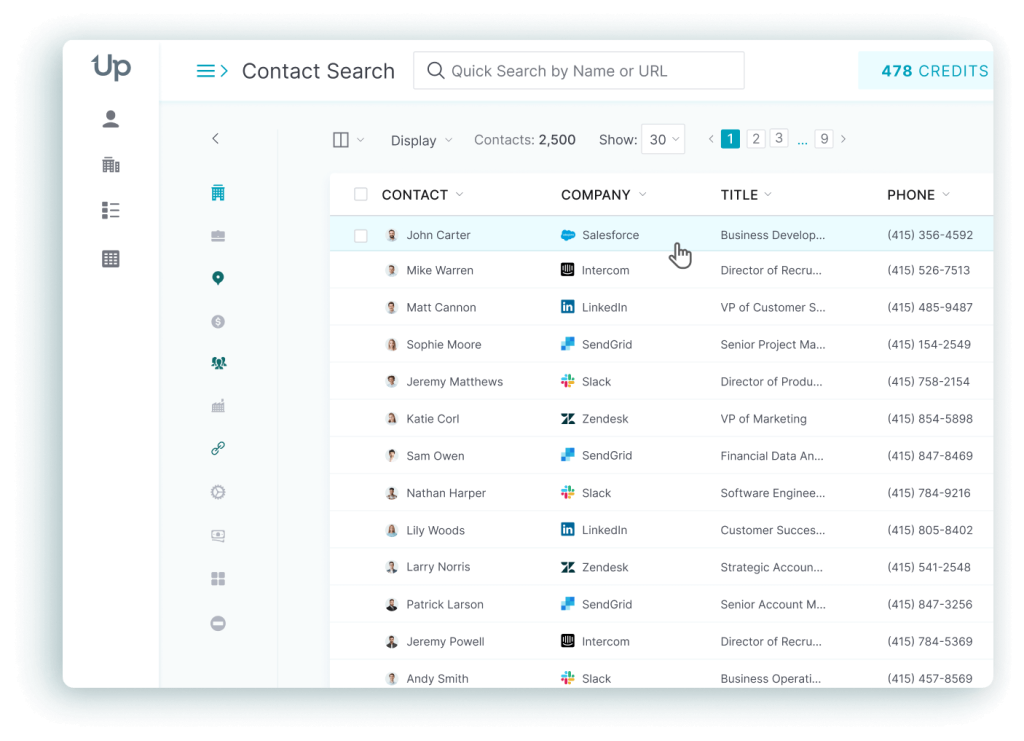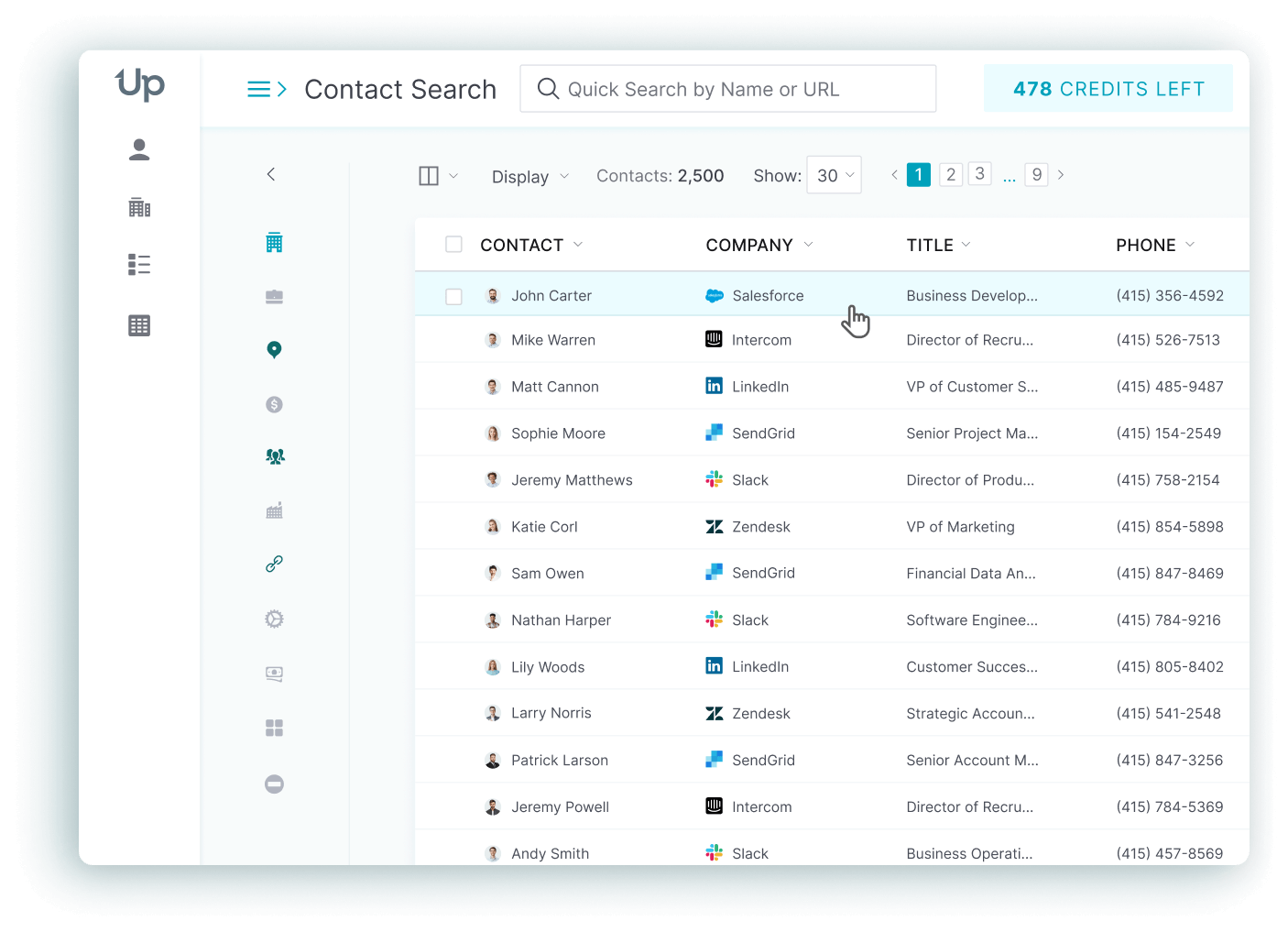


The best buyer intent data provider depends on the signal your team can use right now. This guide explains the differences and breaks down the top providers by use case.
Building a shortlist is easy. Understanding what kind of signal you are actually buying is harder. Some providers focus on web-wide topic research. Some focus on review-site behavior. Others pair intent with company and contact data so sales can act fast. Sort that out first, and the shortlist gets much easier to trust.
What Is Buyer Intent Data?
Buyer intent data is behavioral data that shows when a company or contact is actively researching a problem, category, or vendor. Those data signals can come from first-party data on your own site or CRM, second-party intent data shared by a partner platform or third-party intent signals gathered from content consumption patterns across the web.
Most B2B buyers do not start with a form fill. They read comparison pages, visit pricing pages, research competitors and revisit key pages long before talking to sales. Intent data gives revenue teams a way to spot that movement before a buyer ever raises their hand.
Most teams buy intent before they decide what moment they are trying to catch. Site visits, review-platform comparisons and broad web research are three different signals. Treating them as the same job is where most purchases go wrong.
UpLead Quick Take
Buyer intent data helps teams act before the buyer fills out a form
- Use buyer intent data to spot active research before a prospect asks for a demo.
- Match the tool to the signal you need, first-party, review-led or broad third-party research.
- The best platform is the one your team can trust and use every week.
Why Teams Buy Buyer Intent Data
Teams buy buyer intent data for one reason: better timing. Strong data improves account prioritization, tightens outbound targeting, cuts wasted follow-up on cold accounts and gives marketing a better basis for deciding which segments deserve budget now. The upside is reaching prospects while they are still researching, before a competitor gets there first.
When a platform works, behavior changes. Sales reps stop treating every target account the same. Marketing stops waiting for leads that arrive after months of silent research. RevOps gets cleaner inputs for routing, scoring and sequencing. The hard part is not seeing activity. It is knowing which activity to act on and having the data where the team can do something about it.
What teams say after implementation is more useful than the sales pitch. Disappointed buyers tend to report the same issues: signal arrives too late, too many accounts look active, the company match is unreliable or reps cannot use the data without extra enrichment work. When it does work, reps reorder outreach, marketing can justify segment budget and operations routes activity without manual workarounds.
- Earlier account prioritization: Teams can spot research behavior before an account lands on a branded demo page.
- Better message fit: Outreach is stronger when it reflects what the buyer is already reading, comparing or revisiting.
- Cleaner handoffs: Intent signals can feed scoring, routing and campaign triggers instead of sitting in a separate dashboard.
- Faster shortlist decisions: Good buyer intent data helps teams focus on the few accounts most likely to move now.
Key Features to Look For in a Buyer Intent Data Provider
The best buyer intent data providers combine accurate signals, frequent data refreshes, strong data integration and enough company or contact context to make the signal usable. If a platform is weak on those basics, it turns into a dashboard your team stops trusting, no matter how much data volume it advertises.
Strong and weak intent tools are not separated by dashboard quality. They are separated by whether the data changes what the team does each week. In reviews and user discussions, buyers keep returning to the same four questions: can we trust the company match, can we explain why an account looks active, can we act on it inside systems we already use and does the data stay fresh enough to matter? Accurate matching, source transparency, workflow integration and clean CRM data answer those questions. A long feature list does not.
1. Signal source transparency
The provider should make it obvious whether the signal is first-party, second-party, third-party or hybrid. If the collection model is vague, the quality discussion never gets better later. You need to know where the signal comes from before you can judge freshness, fit or compliance.
Buyers hit this wall early. A vendor promises proprietary intent data, but if you cannot tell whether that means website traffic, review activity, publisher-network consumption or modeled scoring, you have no way to judge what the signal is worth.
2. Freshness and update cadence
Intent only matters when it is timely enough to influence action. A signal that arrives too late behaves like a historical report, not a buying indicator. Freshness matters most for outbound use cases where the team wants to act during active research, not after the buyer has already chosen a shortlist.
Freshness complaints show up constantly in user feedback. Teams lose confidence fast when a platform flags accounts that were active last month but no longer respond to outreach this week. Update cadence matters far more in practice than a polished dashboard.
3. Account identification quality
Some tools are strong at anonymous website visitor identification. Others are built for account-level topic surges across a wider network. You need enough confidence in the company match to identify accounts, identify in-market accounts and trust the next workflow step. A weak company match makes every downstream action noisier.
Plenty of intent tools look impressive until the sales team asks a simple question: do we believe this is the right company? Weak IP-to-company matching, thin account context or noisy territory routing can turn an otherwise useful signal into something reps ignore.
4. Contact and company context
Intent is easier to operationalize when it is paired with firmographic context or direct contact data. If the platform can tell you an account is active but cannot help you identify the right people, accurate contact information or direct dials, you still need another layer to turn the signal into outreach.
Smaller teams lean toward hybrid tools for this reason. A pure signal feed can look impressive, but if you still have to enrich the account, find contacts and map data into your sales tools separately, time to value gets long fast.
5. Workflow activation
Buyers underrate this feature all the time. The platform should activate data inside CRM, marketing automation, account scoring or outbound workflows without heavy manual cleanup. A strong signal that stays trapped in a dashboard is still a weak buying decision.
Workflow friction kills many intent deployments. Teams like the data, but if using it means CSV exports, manual tagging or custom ops work every week, reps stop checking it. Good platforms push the signal directly into CRM, outbound sequencers and scoring models: the tools reps already open every day.
6. Review and evaluation visibility
For software vendors, review-site activity often beats broad topic signals. Buyers comparing vendors, reading reviews and revisiting pricing pages are closer to a decision than buyers reading a category blog. Not every market behaves this way, but in software-heavy categories it is a real differentiator.
Review-led intent works well for software, weakly for broader services and barely at all in categories where purchases happen through referrals or procurement frameworks rather than review platforms.
7. Reporting and attribution
You need to know whether the signal is helping the team make better decisions, not just whether the dashboard looks active. Good reporting should make it easier to connect intent activity to account prioritization, campaign routing, response quality or pipeline progression.
Experienced teams stop caring about vanity charts fast. They want proof that intent changed the order of action and improved results. A platform that cannot connect signals to campaigns, account selection or pipeline outcomes becomes hard to defend in budget reviews.
8. Compliance and governance
The provider should be clear about consent, collection practices, regional coverage and governance controls. This matters even more for European teams, regulated industries and any team comparing first-party behavior with third-party network data.
Compliance is often treated like a procurement checkbox until the legal review starts. Teams operating in Europe or regulated sectors usually need more than generic privacy language. They need confidence that the signal source, retention model and workflow integrations will survive internal review.
Use these eight checks to screen vendors before you get on a demo call.
| Feature | Why it matters | Weak sign |
|---|---|---|
| Source transparency | Defines how trustworthy the signal is | Vague language about proprietary data with no collection explanation |
| Freshness | Determines whether outreach timing is useful | Intent spikes with no clear update cadence |
| Account match | Improves confidence in the company target | Lots of activity but weak company identification |
| Context | Makes the signal easier to act on | No company or contact layer around the activity |
| Activation | Moves data into the real workflow | Signal lives only in a dashboard |
| Review and evaluation visibility | Captures buyers already comparing vendors, not just researching topics | No review-platform signal or partner channel coverage |
| Reporting and attribution | Shows whether signals changed decisions, not just dashboard activity | No connection between intent activity and pipeline or campaign outcomes |
| Compliance | Reduces legal and governance risk | No clear collection or privacy explanation |
What Real Users Complain About in Buyer Intent Tools
Across Bombora, 6sense, ZoomInfo, Leadfeeder and UserGems, public reviews on G2 and TrustRadius show the same pattern: buyers rarely regret the idea of intent data. They regret paying for data tools that their team cannot trust or turn into repeatable action.
The positive themes are consistent across platforms: earlier account visibility, cleaner targeting, better outreach timing. The complaints are where the useful buying lessons live. Bombora reviewers on G2 praise topic breadth and publisher-network coverage but also flag cost, company-data cleanup and extra workflow steps when contact data lives elsewhere. 6sense reviewers praise buying-stage insight and message timing; recurring complaints point to stale data, model opacity and a steep learning curve. ZoomInfo reviewers consistently value contact depth and CRM export but flag outdated records, incomplete org charts and weaker fit in narrower segments. Leadfeeder reviewers appreciate ease of use and fast visitor data, but the same reviews make clear that a visitor identification tool does not cover off-site category research. UserGems reviewers repeatedly praise job-change capture and warm pipeline signals, while some want a stronger experience outside of Salesforce.
Once teams go live, those patterns cluster around five themes.
| Recurring review theme | What buyers like | What public reviews say goes wrong |
|---|---|---|
| Intent prioritization | Reps waste less time on cold accounts and focus on companies that look active now | Bombora and broader ABM-platform users still complain when too many accounts look active without enough context to rank them confidently |
| Account and data quality | ZoomInfo and similar platforms are valued for contact depth and account detail | TrustRadius reviewers still flag outdated records, incomplete org charts and weak fit in some narrow segments |
| Workflow activation | Users love when intent pushes directly into CRM or outbound actions | G2 and TrustRadius reviews keep surfacing manual exports, integration friction or dependence on another layer to reach the right contacts |
| Ease of adoption | Leadfeeder-style tools win trust quickly because the use case is obvious | Enterprise ABM tools often draw complaints about setup time, learning curve and the need for internal process discipline |
| Depth of insight | 6sense and Demandbase-style tools are valued for account-stage visibility and richer prioritization | Users still want more transparency around model logic, fresher data and a cleaner path from account insight to named-person action |
This should change how you evaluate vendors. Ask which tool removes the most friction from your actual motion, not which tool has the most data. A small team with solid website traffic and limited ops support will often get more value from a visitor-identification or hybrid workflow product than from a full predictive platform. A mature ABM team may make the opposite call because it can absorb complexity and benefit from richer account-stage modeling. The review pattern is consistent: teams are happiest when the product matches their operating reality, not when it wins a feature-sheet comparison.
Public review sources used in this section: G2 review pages for Bombora Company Surge, Leadfeeder and UserGems, plus TrustRadius review pages for 6sense and ZoomInfo Sales.
First-Party, Second-Party and Third-Party Intent Data Compared
First-party, second-party and third-party intent data are three different signal models with different scope, confidence levels and activation requirements. Website visitor identification, review intent and broad topic intent are not the same job, and mixing them into one shortlist without separating them makes evaluation harder to trust.
Separate the three signal models before you compare vendors.
| Intent type | What it captures | Best use case | Main tradeoff |
|---|---|---|---|
| First-party intent | Behavior on your site, forms, pricing visits, content downloads, CRM engagement | Fast action on known demand | Only works after the buyer reaches your properties |
| Second-party intent | Behavior on a partner property such as a review platform | Software evaluation and competitor research | Works best when buyers actually use that partner channel |
| Third-party intent | Research behavior across publisher and content networks | Earlier market coverage before a branded visit | Harder to validate if source model and freshness are weak |
First-party intent is the easiest place to start: the signal is concrete and the next action is clear. Second-party intent is most valuable for software vendors where buyers actively use review platforms to compare options. Third-party intent earns its place when the team already has enrichment, routing and scoring in place and needs market visibility before a buyer ever visits.
Reviews back this up. Leadfeeder users on G2 praise quick setup and usable visitor data but flag thinner coverage on smaller companies. 6sense reviewers on TrustRadius rate the prioritization and account research highly, then ask for fresher contact data and less friction to act on it. Simpler tools win on speed. Broader platforms win on depth and lose points when the team is not equipped to use that depth.
Buyer Intent Data vs. Website Visitor Identification vs. Review Intent
Buyer intent data, website visitor identification and review intent are three different signal models. Broad buyer intent shows category research across the web, website visitor identification shows which companies are already on your site, and review intent shows buyers comparing vendors on review platforms.
The right choice depends on buyer type. Choose broad third-party intent when you need earlier market coverage, choose website visitor identification when your site already attracts qualified traffic and choose review intent when software buyers in your market rely on review hubs during evaluation. The real difference is scope: visitor identification tells you about your own website, review intent tells you about late-stage evaluation and broad intent tells you about buying intent before a buyer ever touches your brand.
The table below breaks down each model by the question it answers best.
| Category | Best question it answers | Typical product type |
|---|---|---|
| Website visitor identification | Which companies are already visiting our site? | First-party visitor identification tool |
| Review intent | Which buyers are actively comparing vendors on review sites? | Partner or review-platform intent feed |
| Third-party topic intent | Which accounts are researching our category across the web? | Publisher-network intent platform |
| Hybrid intent plus data | Which active accounts can we identify and contact quickly? | Intent plus company and contact data workflow |
How to Choose the Right Buyer Intent Data Provider
Match signal type, freshness, data resolution and integration depth to the motion your team runs today. Skip that step and you end up with either too much platform or too little workflow support.
Evaluations still go wrong here. Teams start with brand reputation, compare feature sheets and only later hit the questions that actually matter: will reps trust this list, will ops spend half their time cleaning the data, will anyone still open the platform three months in?
| Question | If the answer is yes | If the answer is no |
|---|---|---|
| Do you already get enough qualified traffic? | Start by testing first-party intent | Look at review intent or third-party intent |
| Do buyers compare vendors on review sites in your category? | Prioritize second-party review intent | Do not overpay for review signals you cannot use |
| Do you already have CRM, enrichment and routing in place? | Third-party intent becomes more useful | Hybrid tools may create faster time to value |
| Do reps need named contacts fast? | Favor hybrid platforms with contact data | Pure-play intent can still work if another data layer exists |
| Will legal or regional compliance be a major issue? | Prioritize vendors with clear governance language | Do not ignore it, but it may not be the lead filter |
Guide rule: Buy the signal your team can activate first. The best buyer intent platform on paper still loses to a simpler tool if the simpler tool gets used every week.
One lesson comes up repeatedly in public reviews: the platform that wins is not the one with the longest feature list. It is the one the team trusts enough to use in live routing, outbound prioritization and campaign decisions without building extra process around it first.
Buyer Intent Data Providers Compared
No single buyer intent data provider wins across every buyer segment. The right fit depends on signal type, team size, stack maturity and whether the priority is raw coverage or workflow activation. The table below shows which products fit which segments, where each one is strongest, and where each one falls short.
| Provider | Best For | Not Ideal For | Pricing | Customer Ratings |
|---|---|---|---|---|
| UpLead | Lean outbound teams that want intent plus verified contacts | Large enterprises that need deep ABM orchestration | Free trial; paid plans start at $74/month; higher plans from $149/month; Professional is custom. (Source: UpLead) | G2 4.7/5 Gartner 4.5/5 Capterra 4.7/5 |
| Bombora | Teams that want pure third-party intent data | Buyers who want contacts and activation in one tool | Custom annual pricing through sales. (Source: Bombora) | G2 4.4/5 |
| ZoomInfo | Large outbound and RevOps teams | Smaller teams that want simple packaging | Custom pricing through sales. (Source: ZoomInfo) | G2 4.5/5 Gartner 4.2/5 Capterra 4.1/5 |
| 6sense | Enterprise ABM teams that need predictive stages | Small teams without ABM ownership or process | Custom pricing through sales. (Source: 6sense) | G2 4.3/5 Capterra 4.6/5 |
| Demandbase | ABM programs that want account intelligence and activation together | Teams shopping for a narrow signal-only tool | Custom pricing through sales. (Source: Demandbase) | G2 4.4/5 Gartner 4.5/5 Capterra 4.4/5 |
| Cognism | EMEA-friendly outbound with intent and contact coverage | Self-serve buyers with small budgets | Custom pricing through sales. (Source: Cognism) | G2 4.5/5 Gartner 4.4/5 Capterra 4.7/5 |
| G2 Buyer Intent | Software vendors that care about evaluation-stage research | Markets where buyers do not use G2 heavily | Custom pricing through sales. (Source: G2 Buyer Intent) | G2 4.5/5 |
| TrustRadius for Vendors | Software categories that depend on review-led comparison | Broader B2B categories with weak review-site behavior | Custom pricing through sales. (Source: TrustRadius) | G2 3.5/5 |
| Leadfeeder | Teams starting with first-party visitor identification | Buyers who need off-site category research | Free plan; paid plans start at $99/month. (Source: Leadfeeder) | G2 4.3/5 Capterra 4.2/5 |
| UserGems | Teams that want contact-level signal scoring and execution | Buyers who want classic account-level intent only | Custom pricing through sales. (Source: UserGems) | G2 4.7/5 Capterra 4.7/5 |
Pricing note: This category is heavily quote-driven. Where fixed public pricing is not available, the table uses compact source notes instead of unsupported hard numbers.
| Provider | Proof buyers can verify quickly | What that proof supports |
|---|---|---|
| UpLead | Public pricing page plus strong G2, Gartner and Capterra ratings | Faster budget fit and lower evaluation friction for lean teams |
| G2 Buyer Intent | Official product page shows pricing-page views, category comparisons, competitor comparisons and integrations into Salesforce, HubSpot and Marketo | Late-stage software buying signals plus visible activation paths |
| Demandbase | Recent G2 reviews highlight unified ABM workflows, intent visibility and account prioritization | Account-intelligence depth for mature ABM programs |
| TrustRadius for Vendors | G2 reviews repeatedly point to detailed software comparisons and authentic review research | Better fit for review-led software evaluation than for broad market coverage |
In a live demo, buyers should ask for this kind of activation proof.

Shortlist proof check: Before you buy, ask each vendor to show one live signal, one live workflow and one real export your team would use in the first 30 days.
Reviews of the Best Buyer Intent Data Providers
1. UpLead
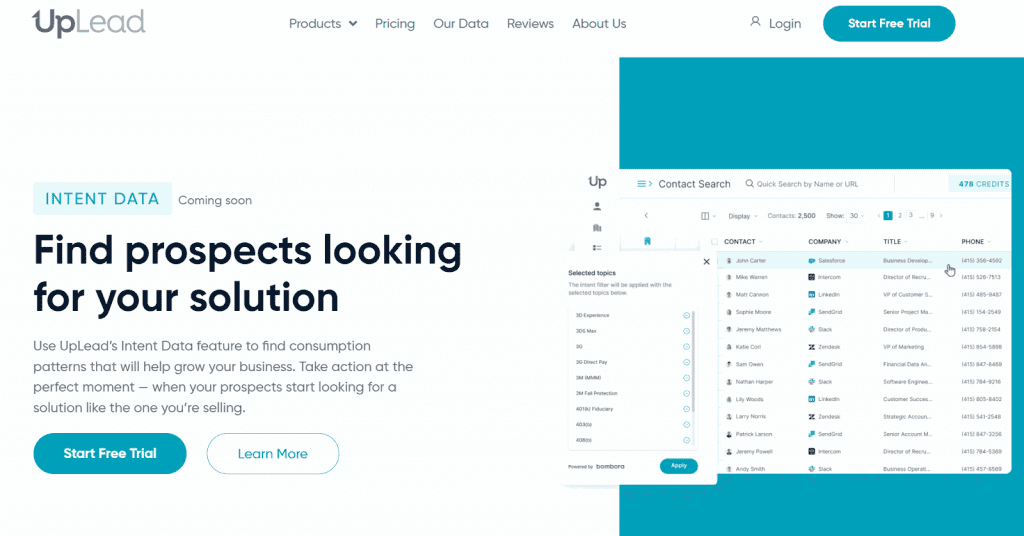
UpLead is a hybrid intent and prospecting platform built for lean outbound and mid-market teams that need active-account filtering and verified contact data in one workflow.
The workflow is straightforward: filter target companies by intent signals, find verified contacts, push records into a CRM or outbound sequence. Smaller teams find it far easier to run than most ABM platforms. Part of that is simplicity. Part of it is that pricing is public. Buyers evaluating intent products often stall because they cannot tell whether a platform is even in budget. UpLead cuts that friction early.
It is not trying to be 6sense or Demandbase. UpLead is not the right tool for predictive account stages, heavy ABM orchestration or enterprise-wide scoring programs. Its value is activation speed for teams that do not need all of that.
Top features
- Intent-based account filtering
- Verified contact and company data
- CRM and export workflows
- Public pricing visibility
- Cleaner path from signal to outreach
- Mid-market and SMB usability
- Simpler operating model than enterprise ABM suites
Pricing: Free trial at $0 for 7 days, Essentials from $74/month billed annually, Plus from $149/month billed annually and custom Professional pricing. (Source: UpLead)
Pros
- UpLead is widely praised for accurate contact data and a low-friction list-building workflow. (Source: G2)
- Verified emails and reliable data quality come up repeatedly in positive reviews as well. (Source: G2)
- Small teams also like the easier prospecting flow, usable filters and straightforward exports. (Source: Capterra)
Cons
- Some reviewers report thinner coverage on smaller companies and edge-case searches. (Source: G2)
- Gartner feedback also points to a narrower operating scope than larger all-in-one platforms. (Source: Gartner)
- More complex searches can slow down, and teams that need deep ABM orchestration often keep larger suites on the shortlist. (Sources: G2, Gartner)
Best for: Lean outbound teams that need active-account filtering, verified contacts and a fast path to outreach in one workflow.
How does it compare: UpLead covers more ground than a pure visitor-identification tool and is much lighter than a full ABM suite. Choose it when your biggest priority is speed to usable lists and outreach. Skip it when you need predictive stages, deep orchestration or enterprise-wide ABM controls.
2. Bombora
Bombora is a specialist, publisher-network intent platform built for demand gen and RevOps teams that already have enrichment and execution in place. It tracks content consumption across a cooperative network of more than 5,000 B2B publisher sites and delivers account-level topic surge signals without the contact database, workflow tools or activation layers that come with a full outbound platform.
Teams that already have enrichment, routing and execution in place often prefer a specialist to a platform that bundles intent as one feature among dozens. Bombora keeps showing up in stacks where the goal is earlier market visibility: spotting research activity before a target account ever lands on the vendor’s website.
That specialization defines the limitation. For a lean team that still needs contact data, segmentation and workflow activation, Bombora is not the fastest path from signal to outreach. A hybrid tool covers more of that ground on its own.
Top features
- Company Surge topic-intent model
- Third-party publisher-network signal collection
- Content-consumption visibility across a broad B2B web footprint
- Deployment into existing data workflows without requiring a full platform migration
Pricing: Custom annual pricing through sales. (Sources: Bombora and G2)
Pros
- Bombora is often praised for broad topic coverage and early account-level visibility. (Source: G2)
- Reviewers also call out the usefulness of Surge signals inside ABM workflows. (Source: G2)
- For teams that already have contact data elsewhere, Bombora’s specialist intent layer is a recurring reason it stays on the shortlist. (Source: G2)
Cons
- Bombora can become slower to operationalize once the team also needs contacts and downstream activation in the same workflow. (Source: G2)
- Some reviewers also mention company-data accuracy issues that create more cleanup work. (Source: G2)
Best for: Mature demand generation and RevOps teams that already have enrichment and execution in place and mainly need standalone third-party intent.
How does it compare: Bombora is stronger than hybrid tools when the priority is pure topic-intent coverage. Choose it when you already have contacts and workflows elsewhere. Skip it when you want one tool that goes from signal to named-person action.
3. ZoomInfo
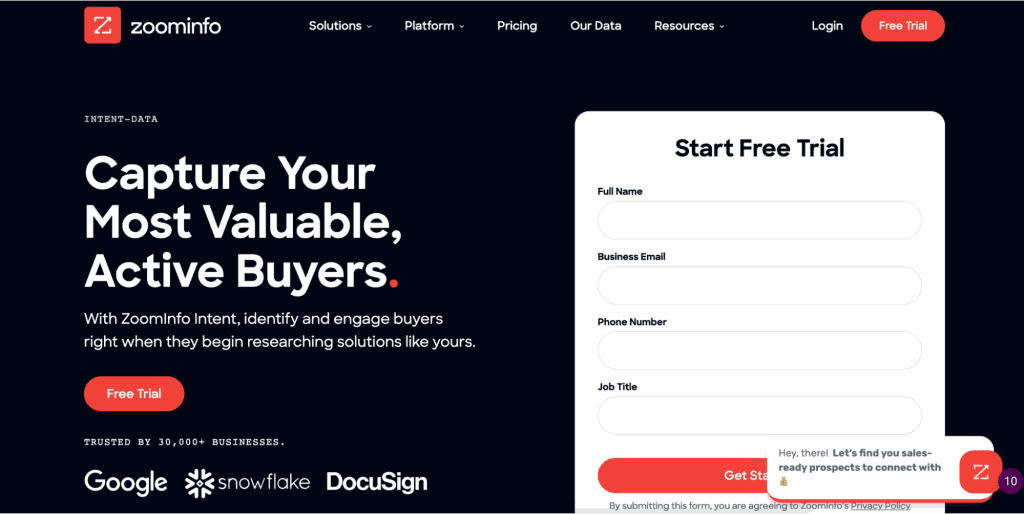
ZoomInfo is a large-scale, all-in-one sales intelligence platform built for enterprise outbound and RevOps teams that need intent, contact data and workflow activation in one system.
Teams that already build lists, enrich accounts and run sales workflows inside ZoomInfo can treat intent as another execution layer without adding a separate vendor. The signal connects to contact data, CRM data and outbound execution rather than sitting in a standalone feed.
Broader capability comes with higher cost and more configuration. For a team that mainly wants intent signals or a fast starting point, the product is heavier than necessary.
Top features
- Broad contact and company coverage
- Intent-driven list building
- CRM and workflow activation
- Direct dials and sales-intelligence depth for larger operations
Pricing: Custom pricing through sales. (Sources: ZoomInfo and G2)
Pros
- ZoomInfo is regularly praised for broad contact coverage and fast prospecting at scale. (Source: G2)
- Buyers also call out strong search filters, account detail and list-building speed for outbound teams. (Source: Capterra)
- On Gartner, the strongest positive theme is still breadth: ZoomInfo is used as a larger sales-data operating layer, not just a narrow intent feed. (Source: Gartner)
Cons
- Accuracy complaints are still common, especially around stale data and too much manual verification. (Source: G2)
- Gartner reviews add a second issue: the platform can feel expensive and heavier than necessary when the real need is simpler prospecting. (Source: Gartner)
Best for: Larger GTM teams that want intent, contact data, company data and workflow activation in one commercial system.
How does it compare: ZoomInfo is a platform-first choice, not a lightweight intent buy. Choose it when consolidation matters more than simplicity. Skip it when the team mainly wants a cleaner, cheaper, faster intent workflow.
4. 6sense
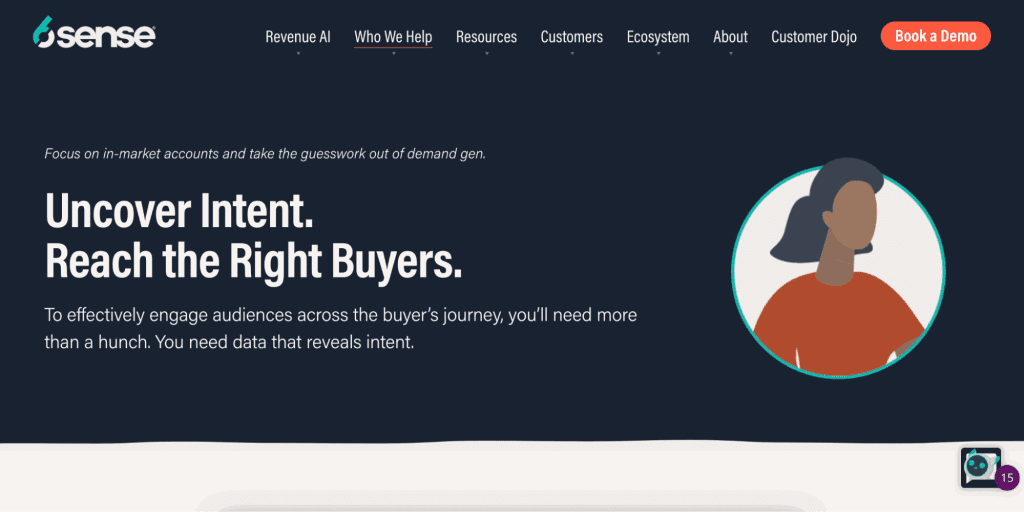
6sense is a predictive, AI-driven ABM platform built for enterprise revenue teams that need buying-stage modeling, account prioritization and full-funnel orchestration. Enterprise buyers shortlist it because they want a system that maps buying stages and feeds a broader ABM motion, not just a list of companies that look active this week.
That puts it in a different category from basic visitor data or a simple account-alert feed. Buying-stage modeling and account prioritization are the core jobs, with raw intent signals as one input. Teams evaluate 6sense when orchestration is the goal, not just awareness.
Predictive orchestration only pays off when the team can support implementation, process design and change management. Smaller teams that want a lighter deployment get more value from a narrower product.
Top features
- Predictive buying-stage views
- Account prioritization workflows
- ABM orchestration
- Account engagement insights for in-market account selection
Pricing: Custom pricing through sales. (Sources: 6sense and G2)
Pros
- 6sense stands out when buyers want prioritization, predictive stages and ABM orchestration. (Source: G2)
- Reviewers also praise intent visibility, audience building and better coordination between sales and marketing. (Sources: G2, Capterra)
- 6sense converts signals into account prioritization and orchestration. Raw volume is not the point. (Sources: G2, Capterra)
Cons
- Complexity is the recurring downside, with repeated complaints about learning curve, platform weight and too much setup for smaller teams. (Sources: G2, Capterra)
- Smaller teams wanting a lighter deployment hit a wall with 6sense fast. (Source: G2)
Best for: Enterprise ABM teams that need predictive stages, prioritization and orchestration around in-market accounts.
How does it compare: 6sense is strongest when the buyer wants a full ABM operating layer, not just another data feed. Choose it when your team can absorb setup complexity. Skip it when speed, simplicity and lower process overhead matter more.
5. Demandbase
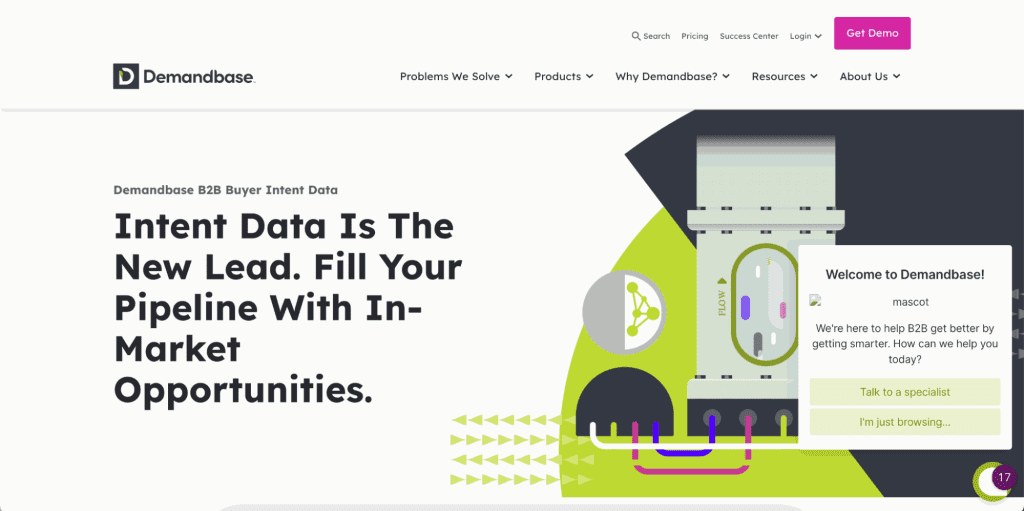
Demandbase is an enterprise ABM platform built for mature sales and marketing teams that want account intelligence, activation and measurement in a single environment. It is designed for teams running targeting, orchestration and measurement in one place rather than bridging multiple tools with constant data sharing.
It works best for mature ABM organizations with strong alignment between sales, marketing and operations. The intent layer is one part of a larger account-based workflow, not the headline feature.
Buyers looking for a clean, narrow intent feed will find the platform heavier than they need. The value scales with how much of the account-based workflow the team actually uses.
Top features
- Account intelligence
- ABM targeting and activation
- Campaign orchestration
- Measurement across sales and marketing
Pricing: Custom pricing through sales. (Sources: Demandbase and G2)
Pros
- Demandbase is praised for unified ABM workflows, intent visibility and account prioritization. (Source: G2)
- Reviewers also highlight the platform’s ability to connect sales, marketing, advertising and data in one operating layer. (Source: G2)
- Teams that need a full account-intelligence system also point to the practical value of AI summaries, playbooks and consolidated account views. (Source: G2)
Cons
- Some reviewers say the platform still needs UI and UX refinement, especially around reporting and day-to-day navigation. (Source: G2)
- Other reviews make it clear that Demandbase works best when the team already has ABM discipline, because setup depth and integration work can feel heavy for smaller teams. (Sources: G2, G2)
Best for: ABM teams that want account intelligence, activation and measurement wrapped around the intent signal.
How does it compare: Demandbase is broader than a point tool and heavier for the same reason. Choose it when you want intent inside a larger ABM system. Skip it when your team mostly wants a narrow signal layer without enterprise workflow weight.
6. Cognism
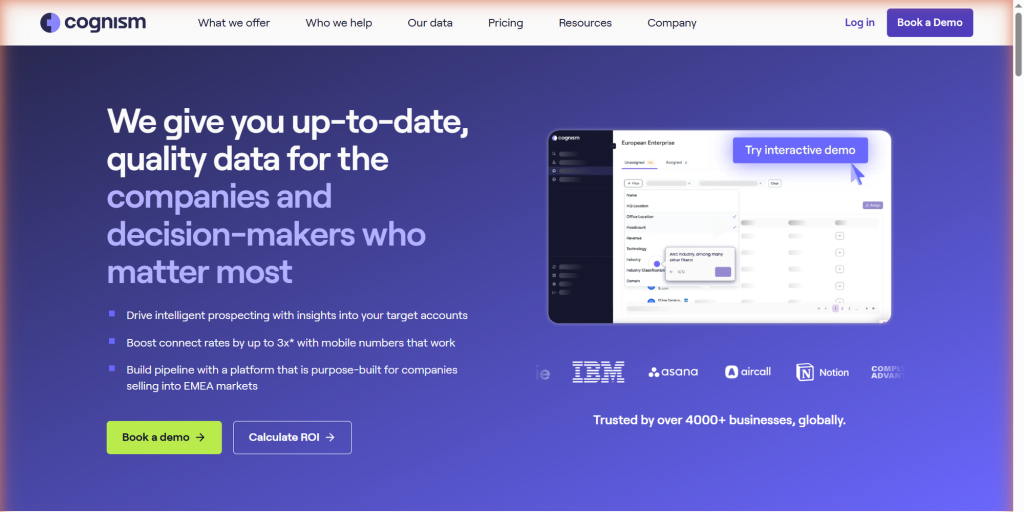
Cognism is a GDPR-compliant sales intelligence platform built for outbound teams with strong EMEA coverage requirements. Most teams evaluate it as a sales intelligence platform that happens to include intent, not as a pure-play intent vendor. That framing is accurate.
Teams that prefer fewer tools and want intent attached to a sales-data workflow find Cognism practical. It has strong EMEA coverage and is designed with GDPR compliance in mind, which matters for European prospecting programs where data residency and consent frameworks affect what you can actually use.
If the priority is the cleanest standalone intent layer, a specialist like Bombora is a better fit. Cognism earns its place when the real need is hybrid execution: intent plus contacts plus activation in one tool.
Top features
- Bombora-powered intent
- Contact and company data
- Outbound workflow fit
- Strong fit for teams with EMEA coverage and compliance requirements
Pricing: Quote-based pricing through sales. (Sources: Cognism and G2)
Pros
- Cognism is regularly praised for strong EMEA data quality and compliance positioning. (Source: G2)
- Verified mobile data and practical day-to-day usability for European prospecting come up often as well. (Source: G2)
- Teams also point to easy list building, fast exports and straightforward CRM integration. (Sources: G2, Capterra)
Cons
- Accuracy is not perfect. G2 and Capterra both include complaints about missing mobiles, bounced emails or weaker data in niche segments. (Sources: G2, Capterra)
- Gartner reviews add a second pattern: solid core usability, but limits in integrations, process automation and some regional coverage. (Source: Gartner)
Best for: Outbound teams that want Bombora-powered intent, contact data and stronger EMEA fit in one sales-data workflow.
How does it compare: Cognism is better for contact-driven outbound teams than for buyers who want the cleanest pure intent specialist. Choose it when regional coverage, mobile data and execution matter more than standalone intent purity. Skip it when you want a self-serve, lower-cost entry point.
7. G2 Buyer Intent
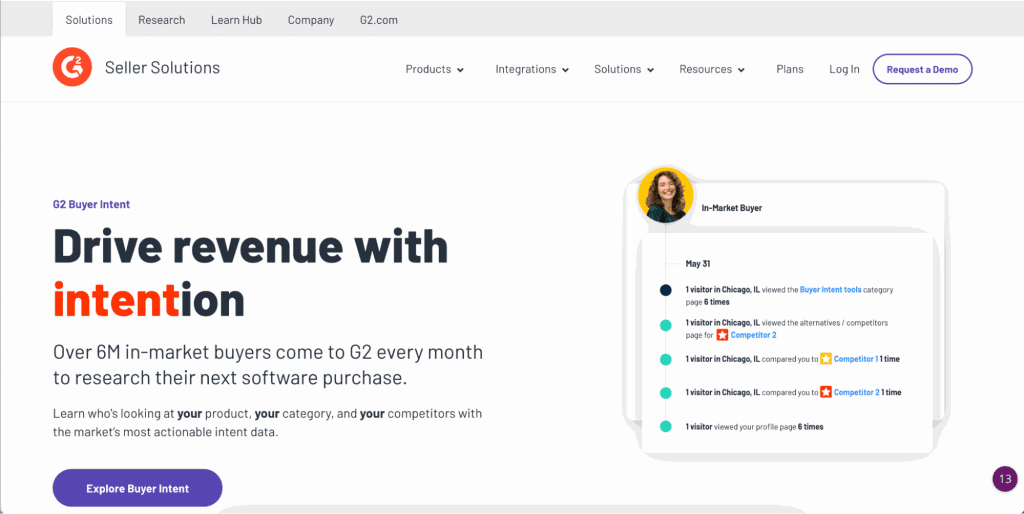
G2 Buyer Intent is a second-party, review-led intent platform built for software vendors that need signals from buyers actively comparing vendors on G2. Those signals: reading reviews, checking pricing pages and researching competitors, sit closer to a purchase decision than a broad topic surge.
The signals indicate evaluation, not just interest. Companies reading product comparisons and revisiting pricing pages are closer to shortlist formation than companies that recently read a category blog post. That distinction makes G2 Buyer Intent more actionable for software vendors than most third-party intent sources.
The signal depends on channel behavior. If buyers in your market do not use G2 to compare vendors, the data thins out quickly. Evaluate this one against actual buying behavior in your category, not just the idea of review intent.
Top features
- Category and competitor comparison signals
- Pricing and review engagement signals
- CRM and marketing activation paths
- Strong fit for software evaluation journeys and late-stage buying intent
Pricing: Custom pricing through sales. (Sources: G2 Buyer Intent and G2)
Pros
- Reviewers praise the platform for useful in-market signals and category-level insight. (Source: G2)
- Ease of use and practical integrations also come up repeatedly. (Source: G2)
- Some teams specifically like that the signals are easy to share internally because they map closely to active software buying behavior. (Source: G2)
Cons
- Some reviewers report noisy signals, manual cleanup work and messy category logic. (Source: G2)
- Other buyers still want better integrations and stronger standalone execution. (Source: G2)
- Pricing is still quote-led, which makes budget fit harder to judge upfront for smaller teams. (Sources: G2 Buyer Intent, G2)
Review sources: G2 Buyer Intent reviews and individual G2 user reviews linked above.
Best for: Software vendors that care most about pricing-page visits, competitor comparisons and other late-stage evaluation signals.
How does it compare: G2 Buyer Intent is narrower than a broad topic-intent platform and much stronger when buyers in your category actually compare vendors on G2. Choose it for software evaluation signals. Skip it when your market does not rely on review-platform research.
8. TrustRadius for Vendors
TrustRadius for Vendors is a review-led intent platform built for software companies that depend on long-form comparison research during late-stage evaluation. The positioning skews toward bottom-of-funnel trust content and detailed vendor comparisons rather than broad category visibility.
It fits software categories where buyers read deeply before deciding. The signals reflect serious evaluation behavior: detailed review engagement, comparison research and competitor pages, rather than early-stage topic browsing.
Category fit matters here more than with broader intent tools. When buyers rely on review content during evaluation, TrustRadius is a strong fit. When the market uses other channels, the signal pool shrinks.
Top features
- Review-led buyer signals
- Competitor research visibility
- Useful fit for software trust motions
- Downstream activation for vendor teams
Pricing: Custom pricing through sales. (Sources: TrustRadius and G2)
Pros
- TrustRadius is praised for detailed software comparisons and broad selection help. (Source: G2)
- Reviewers also describe the platform as useful for authentic software research and real-world buying insight. (Source: G2)
Cons
- Some reviewers say the product breadth is still lighter than larger review marketplaces. (Source: G2)
- Other users are more critical of the review process itself, including complaints about time cost and incentive friction. (Source: G2)
- That makes the fit narrower than broader intent or review-discovery platforms. (Sources: G2, G2)
Review sources: TrustRadius reviews on G2 and individual G2 user reviews linked above.
Best for: Software vendors that depend on review content and long-form comparison research during late-stage evaluation.
How does it compare: TrustRadius is a specialist. Choose it when deep review content matters more than broad market coverage. Skip it when you need web-wide topic intent, higher-volume signals or a broader marketplace footprint.
9. Leadfeeder
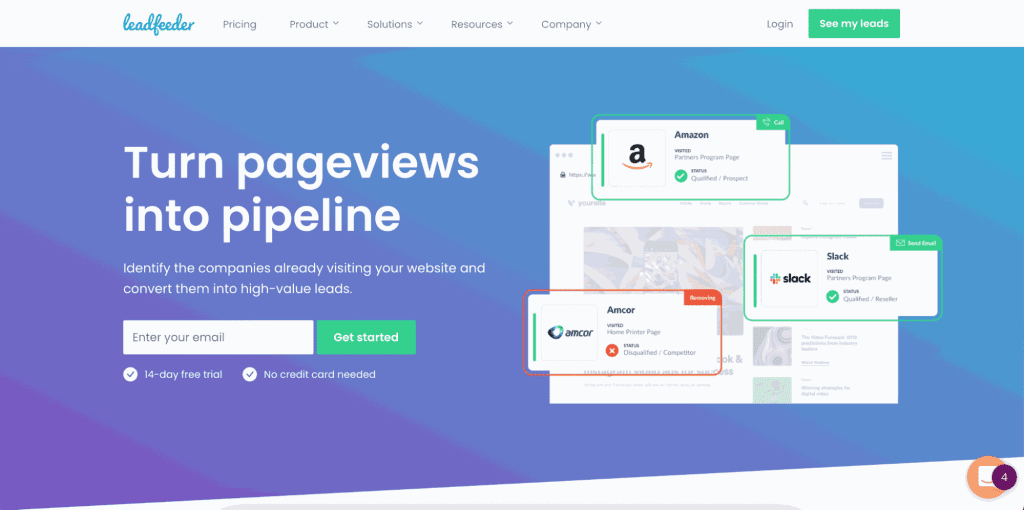
Leadfeeder is a website visitor identification tool built for small and mid-market teams that want fast, low-friction insight into which companies are visiting their site. Teams with steady website traffic use it as a starting point well before they are ready for a larger intent rollout.
For teams that already generate qualified traffic but lack the ops support for a heavier platform, Leadfeeder is a cleaner entry point. It surfaces useful first-party signals without requiring a long implementation cycle, complex routing logic or enterprise-grade orchestration.
The tool stops working the moment a buyer leaves your site. Leadfeeder does not cover off-site category research, does not replace a contact-data stack and is not designed for full-funnel market coverage. Use it when you want to act on existing site traffic, not when you need visibility into accounts that have never visited you.
Top features
- Website visitor identification
- First-party account visibility
- Lower evaluation friction
- Public entry pricing
Pricing: Free plan at $0 and paid plans starting at $99/month, with pricing based on identified companies. (Source: Leadfeeder)
Pros
- Leadfeeder is regularly praised for surfacing warm website accounts quickly and with low setup friction. (Source: G2)
- Ease of use is another recurring strength, especially around quick setup, simple interfaces and practical CRM integration. (Sources: G2, Capterra)
- For small and mid-market teams, the biggest upside is speed to value: useful visitor data without a long implementation cycle. (Sources: G2, Capterra)
Cons
- Lead quality is the main tradeoff, with complaints about vague account-level visibility and lighter contact depth. (Source: G2)
- Capterra reviews add similar complaints around pricing sensitivity for small teams and the need for manual qualification after the visit is identified. (Source: Capterra)
Best for: Small and mid-market teams that want the fastest path into first-party intent and website visitor identification.
How does it compare: Leadfeeder is easier to adopt than a large intent suite and much narrower by design. Choose it when your own site already drives qualified traffic and you want simple first-party visibility. Skip it when you need off-site research coverage or richer contact depth.
10. UserGems
UserGems is a contact-signal platform built for revenue teams that treat job changes and champion movement as buying signals. When a past customer joins a new company or a champion moves into a new role, UserGems finds that moment and routes it into the sales workflow.
It is more opinionated than most intent platforms. The fit is strongest for teams that want contact-level action and pipeline-oriented execution, not a broad neutral signal layer. Revenue teams that track champion movement and relationship history get the most out of it.
Buyers who want classic account-level intent first and contact workflows second will find this tool more specialized than they need. It is not a substitute for a broad topic-intent platform; it covers different territory.
Top features
- Contact-level signal scoring
- Relationship and pipeline context
- Job-change detection and warm-lead identification
- Revenue workflow alignment
Pricing: Custom pricing through sales. (Sources: UserGems and G2)
Pros
- UserGems is widely praised for turning job changes and champion movement into warm pipeline. (Source: G2)
- Reviewers also point to strong CRM integration and automation that save manual prospecting time. (Sources: G2, Capterra)
- The recurring strength is execution speed: identifying a warm contact signal and turning it into outreach fast. (Sources: G2, Capterra)
Cons
- Common limits include occasional delays in job-change updates and data refresh timing. (Source: G2)
- It is also a more opinionated workflow than classic account-intent tools, so buyers that want broad account scoring without contact-level execution may prefer a different platform shape. (Sources: G2, Capterra)
Best for: Revenue teams that want contact-level prioritization, champion tracking and direct follow-through tied closely to action.
How does it compare: UserGems is stronger for contact-level execution than for buyers who want a classic account-level intent layer. Choose it when contact movement and execution speed matter most. Skip it when you want a broader, more neutral account-intent database first.
Which Buyer Intent Data Provider Is Best for Your Role?
Role shapes the shortlist more than company size. Sales leaders gravitate toward UpLead, ZoomInfo or Leadfeeder: tools that get them to verified contacts fast. Demand generation teams lean toward Bombora or Demandbase for earlier category visibility. Enterprise ABM leaders need the orchestration depth of 6sense or Demandbase. The starting question is always the same: what job does this role need the data to do?
| Role | What to prioritize | Best starting points |
|---|---|---|
| Sales leader | Activation speed, contact context, list usability | UpLead, ZoomInfo, Leadfeeder |
| Demand generation leader | Earlier category visibility, campaign triggers, account prioritization | Bombora, 6sense, Demandbase |
| ABM leader | Predictive stages, orchestration, account intelligence | 6sense, Demandbase |
| Software marketing team | Review-led evaluation signals and competitor research | G2 Buyer Intent, TrustRadius for Vendors |
| RevOps | Source transparency, workflow activation, governance | ZoomInfo, UpLead, Bombora |
Sales leaders buying a platform that produces dashboards instead of usable lists waste time on the wrong tool. ABM leaders buying a narrow point solution discover it cannot support orchestration. Software marketing teams buying review intent in a market where buyers use referrals instead of review sites end up with thin signals. Each role has a different failure mode.
At a Glance
Sales leaders should bias toward speed. ABM leaders should bias toward orchestration depth.
Software marketing teams should buy review intent only when buyers in the category really use review sites. RevOps should care most about source clarity, integrations and daily usability.
Implementation Trade-Offs to Consider Before You Buy
Implementing buyer intent data means balancing speed, data quality, privacy and workflow complexity. Most failed purchases come from underestimating one of those trade-offs during evaluation. The real question is whether your team can trust the signal, route it cleanly and use it without adding a steep learning curve to day-to-day execution, not just whether you can get more data points into the stack.
Run through these trade-offs before you get to a vendor demo.
| Tradeoff | When to lean left | When to lean right |
|---|---|---|
| Depth vs. speed | Choose speed when the team needs adoption and fast workflow impact | Choose depth when ops and ABM processes are mature enough to use it |
| Coverage vs. confidence | Choose confidence when reps need signals they can explain easily | Choose coverage when the goal is earlier market visibility at scale |
| Account vs. contact resolution | Choose account-level insight for ABM prioritization | Choose contact-level detail when outbound execution is the main job |
| Signal vs. workflow | Choose pure signal when the rest of the GTM stack is already strong | Choose workflow-heavy tools when the team needs contacts and activation in one place |
| Flexibility vs. procurement friction | Choose lighter packaging when budget clarity and fast rollout matter | Choose enterprise packaging when customization matters more than speed |
After you review the trade-offs, use this checklist to pressure-test the shortlist.
Checklist
- Confirm the signal source.
- Test one live workflow.
- Verify account match quality.
- Check contact handoff.
- Make sure one sales team will use the data every week.
Small teams should start with the signal that is easiest to act on every week. Mature teams running account scoring, CRM automation and outbound segmentation can absorb a broader platform and get more out of it. Either way, buy for the stack you have today, not the one you plan to build.
Which Buyer Intent Data Provider Should You Start With?
Match the provider to the motion your team already runs. The fastest path to value is the tool that fits the workflow you have today, not the most ambitious future-state stack.
| If this sounds like you | Start with | Why |
|---|---|---|
| We need a practical all-around option for lean outbound | UpLead | Hybrid workflow with verified contacts and lower evaluation friction |
| We already have the stack and need pure third-party intent | Bombora | Specialist signal layer with broad topic coverage |
| We want a large sales-data platform with intent built in | ZoomInfo | Platform fit for larger teams that want consolidated workflows |
| We run enterprise ABM and need predictive stages | 6sense | Stronger fit for prioritization and orchestration at enterprise scale |
| We want account intelligence and activation in one ABM platform | Demandbase | Useful when intent is one part of a broader ABM system |
| We care most about review-led software buying signals | G2 Buyer Intent or TrustRadius for Vendors | Closer to vendor-evaluation behavior than broad topic surges |
| We want a light first-party starting point | Leadfeeder | Simple way to begin with website visitor identification |
| We want contact-level signal scoring tied to action | UserGems | Opinionated fit for contact-level prioritization and workflow execution |
FAQ About Buyer Intent Data Providers
How much does buyer intent data cost?
Buyer intent data ranges from low-cost first-party tools to custom enterprise contracts. UpLead and Leadfeeder publish entry pricing. Most larger ABM and intent platforms still sell through custom quotes.
Is first-party or third-party intent data better?
First-party intent is better for confidence and fast action. Third-party intent is better for earlier market visibility. Second-party intent sits in the middle when a partner platform captures strong evaluation behavior. Most smaller teams should start with first-party intent or a hybrid tool, then add third-party data later if the workflow already works.
Are review-intent tools only useful for software companies?
Review-intent tools are most useful when buyers rely on review platforms during vendor evaluation. That makes them strongest in software and much weaker in broader B2B markets where buyers research through other channels.
Can small teams use buyer intent data well?
Small teams can use buyer intent data well if they start with one narrow, high-confidence use case. For most small teams, that means Leadfeeder, UpLead or another light first-party or hybrid workflow, not a heavy predictive platform that needs a larger ops motion.
The Bottom Line
The best buyer intent data provider depends on what kind of signal your team can use right now. UpLead is the strongest practical choice for lean outbound teams. Bombora is the clearest pure third-party specialist. Leadfeeder is the easiest first-party starting point. G2 Buyer Intent and TrustRadius make sense when software evaluation behavior matters more than broad topic coverage. 6sense and Demandbase fit buyers who truly need an enterprise ABM operating layer.
If your team wants a lighter path from active-account filtering to verified contact export, UpLead is worth a look.